Info
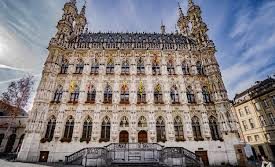
Leuven Town Hall is one of the most famous Gothic town halls in the world and stands on the Grote Markt in Leuven.
The plans for Leuven’s town hall were based on and inspired by Bruges Town Hall. Bruges’ town hall is one of the oldest in Belgium and, in addition to Leuven’s, was the model for the town halls of Oudenaarde, Brussels and Ghent, among others. For the bricks, they made use of Lediaanse stone from quarries such as De Helle in Dilbeek.
The town hall has three floors. Between the windows there are two niches, which protrude slightly. Three of the four corner towers also have niches. The corbels are sculpted representations of the Bible. The recurring subject is guilt and penance. They had a pedantic and admonishing function. During the first restoration in the nineteenth century, most of them were replaced; however, the original corbels rest in the attic of the Town Hall.
Since the city services moved to the municipal offices on the Professor Roger Van Overstraetenplein (near the station), the historic Town Hall has only been used for ceremonies.
History
The building today known as the Town Hall was the Voirste Huys (front house) of a larger complex of municipal buildings on which construction started in 1439 at the site of an existing Town Hall. The first architect, Sulpitius Van Vorst, died soon after the back wings of the complex got started and was succeeded briefly by Jan Keldermans II, whose death in 1445 ended the first construction campaign.
The project resumed in 1448 under the direction of Matheus de Layens. The first stone of the Voirste Huys was laid on 28 March of that year. The cellars of some demolished houses were incorporated into the new construction and can today be accessed through a small door at the left side of the Town Hall. The initial plans, influenced by Brussels’ Town Hall, included a belfry tower at one of the corners. This design was modified by de Layens, resulting in the symmetrical arrangement of turrets observed today.
The exterior masonry and roof were finished in 1460, and in 1469 the building was complete.